
Use case example: Evolution of Sovereignty Attitudes
Source:vignettes/analysis-sovereignty.Rmd
analysis-sovereignty.RmdThis page uses the merged file to estimate sovereignty support over time.
Show code used in this page
library(dplyr)
library(ggplot2)
library(knitr)

pkg_master <- system.file("extdata", "qes_master.csv", package = "qesR")
master_paths <- c("qes_master.csv", "../qes_master.csv", pkg_master)
master_paths <- master_paths[nzchar(master_paths)]
master <- read.csv(master_paths[file.exists(master_paths)][1], stringsAsFactors = FALSE)

master <- master %>%
  mutate(
    qes_year_chr = trimws(as.character(qes_year)),
    qes_year_num = as.integer(substr(qes_year_chr, 1, 4))
  )

is_range <- grepl("^[0-9]{4}-[0-9]{4}$", master$qes_year_chr)
start_year <- suppressWarnings(as.numeric(sub("^([0-9]{4})-([0-9]{4})$", "\\1", master$qes_year_chr)))
end_year <- suppressWarnings(as.numeric(sub("^([0-9]{4})-([0-9]{4})$", "\\2", master$qes_year_chr)))

master$study_period <- ifelse(
  is_range,
  master$qes_year_chr,
  ifelse(!is.na(master$qes_year_num), as.character(master$qes_year_num), master$qes_year_chr)
)
master$period_order <- ifelse(
  is_range & is.finite(start_year) & is.finite(end_year),
  (start_year + end_year) / 2,
  master$qes_year_num
)

master$sovereignty_support <- suppressWarnings(as.numeric(master$sovereignty_support))
master$sovereignty_support[!(master$sovereignty_support %in% c(0, 1))] <- NA_real_

all_periods <- master %>%
  filter(!is.na(study_period), nzchar(study_period), !is.na(period_order)) %>%
  distinct(study_period, period_order)

sov <- master %>%
  filter(!is.na(study_period), nzchar(study_period), !is.na(period_order)) %>%
  group_by(study_period, period_order) %>%
  summarise(
    respondents = n(),
    n_with_measure = sum(!is.na(sovereignty_support)),
    support_share = ifelse(n_with_measure > 0, mean(sovereignty_support, na.rm = TRUE), NA_real_),
    se = ifelse(n_with_measure > 0, sqrt(pmax(support_share * (1 - support_share), 0) / n_with_measure), NA_real_),
    ci_low = ifelse(!is.na(se), pmax(0, support_share - 1.96 * se), NA_real_),
    ci_high = ifelse(!is.na(se), pmin(1, support_share + 1.96 * se), NA_real_),
    .groups = "drop"
  )

sov <- merge(all_periods, sov, by = c("study_period", "period_order"), all.x = TRUE, sort = TRUE)
sov <- sov %>% arrange(period_order, study_period)
sov$period_index <- seq_len(nrow(sov))

knitr::kable(sov)
The estimates below use the dedicated sovereignty question harmonized across study periods.
Table 1: sovereignty support by study period
| Study period | N respondents | N with sovereignty item | Sovereignty support (%) | 95% CI (%) |
|---|---|---|---|---|
| 1998 | 1483 | 381 | 43.3 | 38.3 to 48.3 |
| 2007 | 9244 | 8207 | 40.1 | 39.0 to 41.1 |
| 2008 | 11162 | 10379 | 40.1 | 39.2 to 41.0 |
| 2009 | 8008 | 7455 | 39.3 | 38.2 to 40.4 |
| 2010 | 1000 | 923 | 39.9 | 36.7 to 43.0 |
| 2012 | 2349 | 2066 | 40.1 | 38.0 to 42.2 |
| 2014 | 1517 | 1353 | 34.1 | 31.6 to 36.7 |
| 2018 | 4322 | 3338 | 33.6 | 32.0 to 35.2 |
| 2022 | 1521 | 1284 | 36.4 | 33.7 to 39.0 |
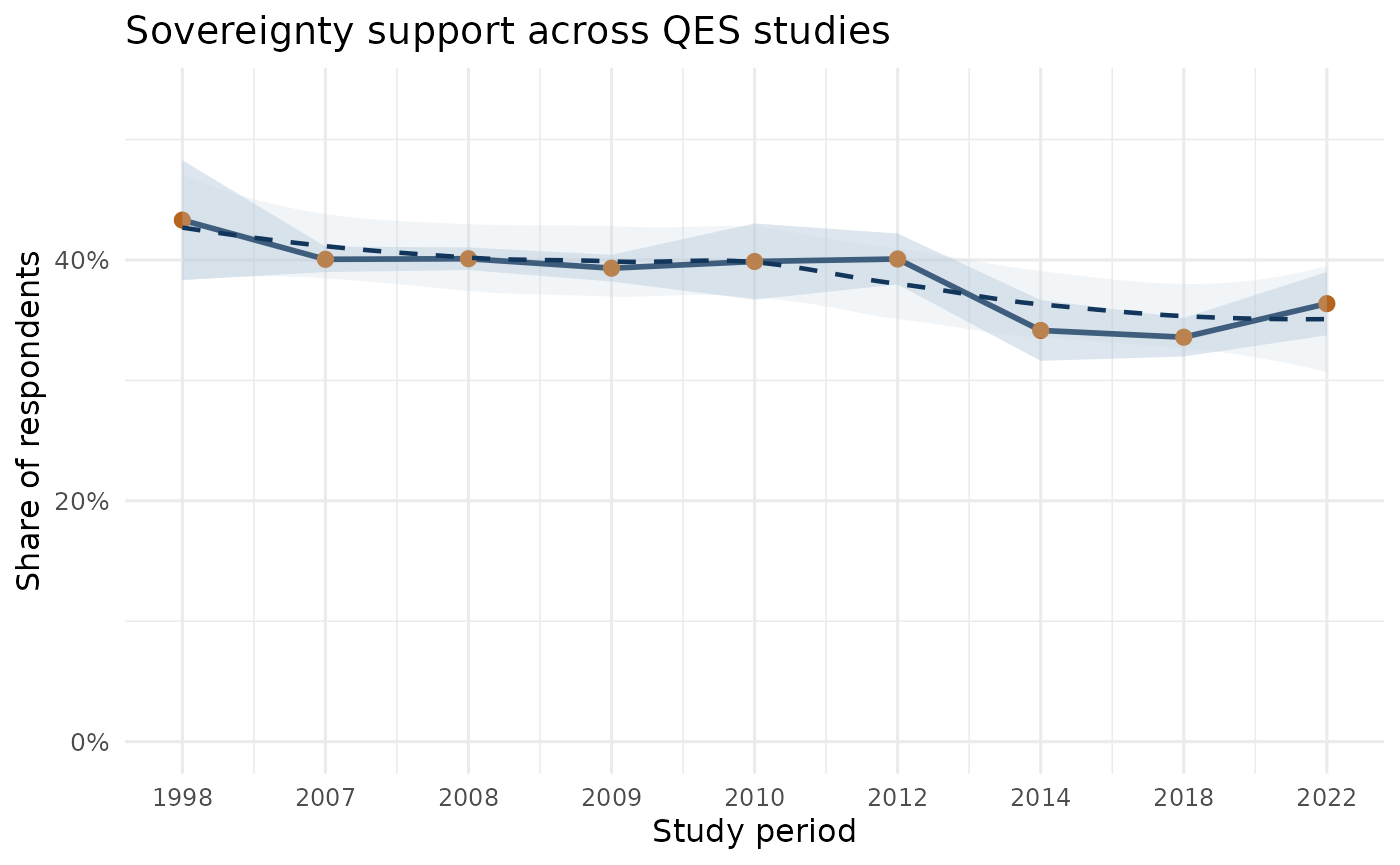
Notes
- The sovereignty trend uses the dedicated sovereignty item from each study.
- The
qes_crop_2007_2010study is split into 2007, 2008, 2009, and 2010 using its collection-wave date variable. - Confidence intervals are binomial 95% intervals using normal approximation.
-
n_with_measurein the table shows where coverage is thinner.